

Engaging across differences
Winter transforms our homes into a cocoon of warmth and rest. We seek comfort in close quarters, drawn by the allure of a crackling fire, nourishing meal, or steaming drink.
We also tend to gather with those who offer easy, conflict-free connection. As a result, our social circles shrink, and we often end up surrounded by people who think, behave, and look a whole lot like us.
The problem with this is that comfort rarely leads to meaningful change. On the flip side, people who challenge our perspectives offer opportunities for personal and relational growth.
This season, as we gather at tables for holidays or interact with others in our day-to-day activities, consider what we have in common, and how we can engage across our differences.
We All Belong Together
We are most attracted to people who share our beliefs, values, hobbies, and even physical traits. That is partly because our early ancestors relied on the protection of groups for their survival. Greater similarities meant greater cohesion – and lower chances of being cast out of the group.
Belonging still enhances our sense of safety, even though it’s no longer necessary for our survival. It allows us to retreat from the larger world and let our guards down. Belonging can come to us in the form of friendships, romantic love, family, colleagues, and social groups. We may also find belonging in our homes, churches, and even with pets.
But sometimes we falsely believe that in order to belong, we must adjust the way we act or think. This belief can lead to people-pleasing, poor boundaries, or abandoning our sense of self to fit in. It can also lead to a distrust or hatred of “outsiders.” Bullying, hate crimes, racism, and homophobia are all rooted in a need to extinguish differences.
Attempting to drive out differences also stops us from finding an even deeper sense of belonging for ourselves. Because as long as we are fearful of differences, we will remain closed off to what makes us unique in this world.
Now, perhaps more than ever, we must come to understand, accept, and even cherish each other’s differences. This can bring a greater sense of empathy, warmth, and connection with others. When we step outside of our social circles with compassion, we can remember that we all belong to each other and this planet in our shared humanity.

How to Change Your Mind
If you realize your way of thinking has stopped you from connecting with others, it might be time for a mindset shift. In fact, many therapists operate under the assumption that change must first take place in the mind in order for it to truly take hold.
Cognitive-Behavioral Therapy (CBT), is a form of therapy developed by American psychiatrist Aaron Beck. In CBT, therapists help clients analyze, interrupt, and eventually change thought distortions, which are patterns of thinking that are inaccurate or irrational.
One common thought distortion is all-or-nothing thinking. For example, thinking that friends must agree on everything, or that people who don’t act like you can’t be trusted, or that if you don’t succeed at first, you never will.
To spot this type of thinking, look for words like, “always” or “never.” For example, “Liberals and conservatives will never see eye-to-eye” or “I will always agree with people who share my religious beliefs.”
We can start accepting differences by challenging thoughts that tell us a person’s background, political stance, or religious beliefs define who they are as a human. We can use our common humanity as a touchstone to remind us that despite our differences, we also have similarities.
Strengthen Your Sense of Self
There are three skills that can greatly enhance our ability to accept – or at least tolerate –differences in others: differentiation, self-regulation, and boundaries.
– Differentiation
Differentiation, a concept developed by American psychiatrist Murray Bowen, is the ability to connect and interact with others while staying rooted in your sense of self. The stronger your sense of differentiation, the more you will be able to tolerate perspectives that do not align with our own.
We are most threatened by differences when our sense of self is weak, or our beliefs are fragile or unexamined. If you find yourself resistant to new ideas, it might be a sign that your own ideas need examining. Differentiation can help you to open up your mind to hearing new perspectives – without feeling like your sense of self is being compromised.
– Self-Regulation
When we’re confronted with beliefs and perspectives that challenge our own, self-regulation is often required. Self-regulation is the ability to manage your own emotions while working through emotionally charged conversations and conflicts. Without it, we’re prone to fits of rage or shutting down at the first sign of conflict.
The ability to self-regulate when someone does not agree with you is a form of maturity and self-control. It is a skill that takes time to learn. If you struggle with self-regulation, a therapist can help you to develop coping strategies.
– Boundaries
Losing emotional control can also signal a need to set boundaries before things escalate.
Healthy boundaries are firm yet flexible, communicating what we need and expect. When our boundaries are respected, it builds trust.
Boundaries allow us to listen to the opinions and feelings of others without taking them personally, understanding that differences are not meant to threaten our sense of self.
We will find greater peace in our communications when we accept that we cannot control or change another person by force, just as we hold the personal boundary that we will not tolerate other’s attempting to force us into change.
Improve Your Communication Skills
Once we have the internal resources necessary to connect with others despite differences, we can work on strengthening our communication skills.
– Empathy
When we approach others with curiosity, rather than an agenda, we strengthen our ability to learn. You’ll often find it’s easy to respect someone’s differences when you use empathy to understand the life experiences that shaped them.
– Active Listening
Active listening requires that we are present as much as possible, setting aside our own thoughts and feelings while listening to the thoughts and feelings of others.
This means we listen to understand instead of listening to change minds. On the flip side, we speak to feel heard instead of attempting to influence or control. The end goal is mutual understanding.
– Reflective Listening
Practice reflective listening by reflecting back the feelings and thoughts of others. Don’t repeat what they say word-for-word. Instead, reflect back the feelings you hear them expressing. You don’t have to agree with their perspective in order to understand where they’re coming from. Feelings are something we all have in common.
– Perspective Taking
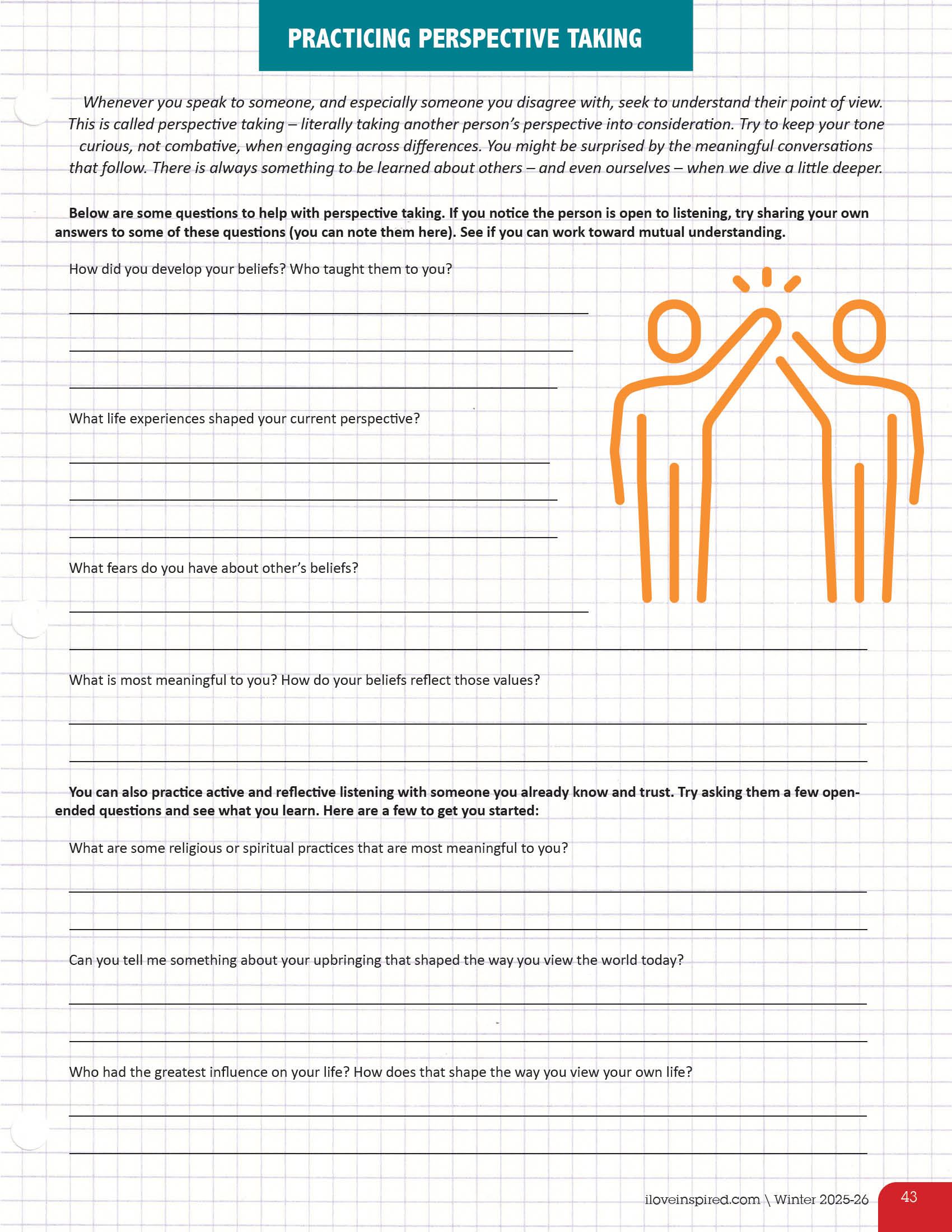
Whenever you speak to someone, and especially someone you disagree with, seek to understand their point of view by asking questions about what shaped their beliefs and ideals.
See the following worksheet for conversation starters and open-ended questions.
Put it all Together for Healthy Conflict Resolution Skills
Conflict is a normal and healthy part of relationships – and can be a major source of personal and relational growth – but how you navigate it matters.
When you’re looking to resolve a conflict, both parties need to be willing to communicate, and both need the space to express feelings of hurt or remorse. Empathy, perspective-taking, and active listening are key. It’s crucial that we set our own feelings aside while we listen. We must seek to understand rather than to control the situation.
Use self-regulation in order to approach communication respectfully and set boundaries so you are able step away from the conflict if self-regulation is needed.
Once both parties feel heard and understood, the next step is to take accountability by acknowledging wrongdoing. We grow when we express what we learned through conflict. We build trust by sharing what we’ll do differently next time (and actually doing it).
What Do We Have in Common?
“What do we have in common?” is an essential question that can open doorways to deep connectedness.
We are driven to seek out others who are most similar to us, but those similarities are often only surface level. We may find a more meaningful sense of belonging by working harder to find deeper commonalities.
When words will not suffice, we can connect through shared experiences. One way to bond is through moving our bodies together. Seek out group experiences – like running, dancing, walking, or practicing yoga – that will expose you to many different people. Notice how connection deepens through this synchronicity.
We can also bond through something called positivity resonance, a moment of shared positive emotion that strengthens connection. Seek out moments of laughter, fun, or joy in the presence of others. These universal emotions transcend language, culture, political, and religious beliefs.
Grow Through Differences
Working through differences can strengthen our connection to self and others. New perspectives offer us the opportunity to examine our own values, beliefs, and lifestyle. Change is not required, but we may find it warranted. Encountering differences may fundamentally change how we view ourselves and the world. That can feel scary at first. If it feels too difficult, a mental health professional can help.
Once we work through our aversion to differences, growth is waiting on the other side. We can emerge with a stronger sense of self, a deeper connection to our values, and a more balanced understanding of our world as a whole.

Olivia Lynn Schnur
Olivia Lynn Schnur holds a Master of Arts degree in Clinical Mental Health Counseling. She is a Licensed Mental Health Counselor, Licensed Professional Counselor, EMDRIA Certified EMDR Therapist, and 200-Hour Certified Yoga Teacher. To learn more, or to book a yoga session, visit oliviaschnur.com.