

Sponsored by

Agora Arts
Agora Arts is a contemporary fine craft gallery located in the heart of beautiful downtown Decorah, Iowa. Agora has been connecting art and artists to the people of the Driftless since 1992, carrying the work of 200+ talented American artists – including lovely art, jewelry, pottery, prints, sculpture, and more. A brainchild of Decorah native and Luther College grad, Gail Bolson-Magnuson, Agora is most definitely a must-stop spot on any visit to Decorah.
Sponsored by

Your Business!
Oh hey, lookie there – you’re looking here! Can you imagine how many people will look at YOUR business in this spot as well?! Let us write a super-fun business blurb for you, upload it and your logo, and watch the hits come in! Plus, you get to support positive news and community-building in the Driftless! Win + Win! Please reach out for more web sponsorship info – we’d love to make it happen!
How to Embrace Change & Learn from Experience
Sponsored by
Agora Arts
Agora Arts is a contemporary fine craft gallery located in the heart of beautiful downtown Decorah, Iowa. Agora has been connecting art and artists to the people of the Driftless since 1992, carrying the work of 200+ talented American artists – including lovely art, jewelry, pottery, prints, sculpture, and more. A brainchild of Decorah native and Luther College grad, Gail Bolson-Magnuson, Agora is most definitely a must-stop spot on any visit to Decorah.
Sponsored by
Your Business!
Oh hey, lookie there – you’re looking here! Can you imagine how many people will look at YOUR business in this spot as well?! Let us write a super-fun business blurb for you, upload it and your logo, and watch the hits come in! Plus, you get to support positive news and community-building in the Driftless! Win + Win! Please reach out for more web sponsorship info – we’d love to make it happen!
The seasons are shifting once more. The bluffs will shine with brilliant red, gold, and orange hues. Then the leaves will eventually fall and create a delicious scent of decay in the crisp autumn air. It’s a routine we rely on; a predictable sort of change.
Change is one of the few constants in life, but it’s not always easy to recognize when it’s happening within our own minds. We often think of our personalities, thoughts, feelings, and beliefs as fixed, but they’re not. Like the leaves, we are ever evolving in response to changes in our environment.
How can we learn to acknowledge these shifts, and find the life lessons in our experiences? A lot of that comes down to learning who you are (and are not).
Your ‘Big Five’ Personality Traits
In psychological research, we often see personalities distilled down into five core traits, referred to as the “Big Five” personality traits. They are: openness to experience, conscientiousness, extroversion, agreeableness, and neuroticism (OCEAN).
We all have some aspect of each of the Big Five personality traits. Knowing whether you score high or low in each domain can help you understand your unique personality strengths and potential challenges. Below are just a few examples to help you get an idea of where you land.
As you read, keep in mind that scoring high or low on any personality trait is neither good nor bad; it’s just where you are right now.
•Openness to Experience
Openness to experience represents your desire to seek out novel ideas, experiences, and connections. You likely score high in this domain if you enjoy conversations, cultures, and experiences that challenge your perspective. You probably enjoy novelty in the form of travel, learning, or creativity. You embrace growth and change but may struggle with routine and the more mundane aspects of life.
If you score low in openness to experience, you probably appreciate stability and predictability. Meeting others who share your values and beliefs can feel comforting. You might enjoy the status quo and see no reason to change. However, you’ll want to be careful not to get stuck in a rut or too set in your ways.
• Conscientiousness
Consciousnesses represents your attention to detail, responsibility, and productivity. If you are highly conscientiousness, you’re likely a self-starter, organized, and efficient. You follow through with commitments and can work at a steady pace. But you may need to keep perfectionism and a desire for order in check.
If you fall within the lower levels of conscientiousness, you may be more spontaneous and impulsive. You likely thrive in flexible and fast-paced environments but may struggle with procrastination or task completion.

• Extroversion
Scoring high in extroversion means you gain energy from others (AKA: you’re extroverted). You’re more likely to seek out social interactions, work well in lively and engaging environments, and enjoy sharing space and ideas with others.
If you score low in extroversion (AKA: you’re introverted), you recharge by spending time alone. You may enjoy being with others, but too much social interaction drains your energy. You’re more likely to enjoy solitary work and quiet environments.
• Agreeableness
The domain of agreeableness looks at your preferences around cooperation, teamwork, social cohesion, and flexibility. If you’re highly agreeable, you’re more likely to set aside your own preferences for the good of a group, trying to find compromises and solutions that feel good for everyone. However, you’ll want to be careful not to fall into people-pleasing habits.
If you score lower in agreeableness you might be more independent, prioritizing your own needs and feelings instead of compromising. If this is you, you may work better in competitive environments that require making difficult decisions. However, being too independent or self-focused can make relationships more difficult.
• Neuroticism
Neuroticism represents your level of sensitivity and emotional stability. High scorers in this domain might struggle to regulate emotions or experience a broad range of emotional fluctuations within a shorter period of time. You likely feel your emotions deeply and may find joy in expressing them through art or writing.
Those high in neuroticism will likely benefit from working with a therapist to ensure your emotional sensitivity does not lead to rumination, excessive worry, or instability in relationships.
If you score low in neuroticism, you might perceive yourself as calm, resilient, or capable of managing your emotions. This can help you experience greater stability in relationships and sense of self, but it may also lead to difficulties expressing empathy or sensitivity.
How Personalities Change
Although our personalities are relatively stable, they can change with age and experience. Many of us will develop higher conscientious and more agreeableness in adulthood as we navigate changing roles in our work, family, and community. Furthermore, we tend to build greater resiliency and emotional stability with age – therefore reducing levels of neuroticism.
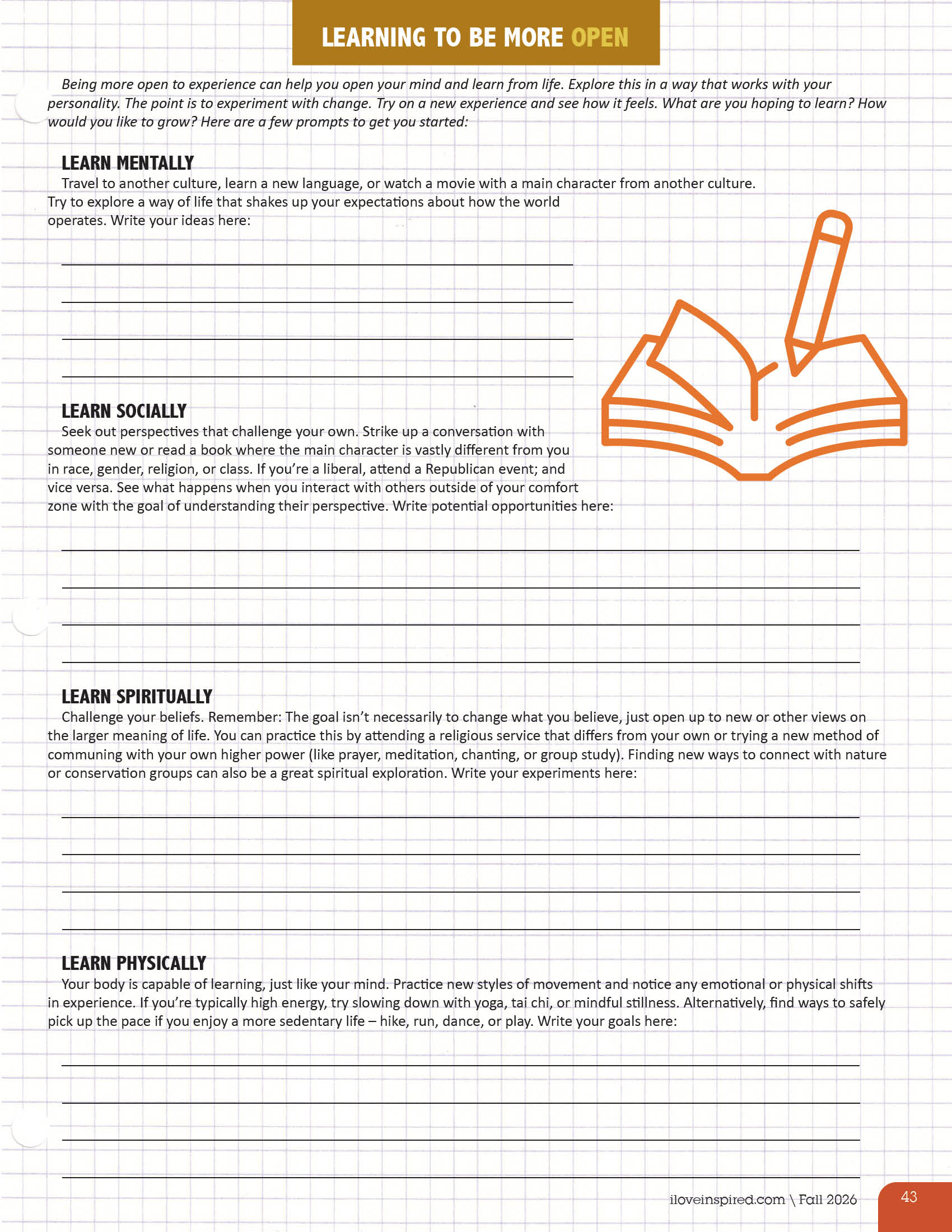
If you find you’re wanting a little change or growth in your life, practicing openness can help. People with high levels of openness to experience (the first domain we discussed) are often well-suited to learn from their experiences. Even if you’re quite low in this domain, there are times when you might benefit by remaining more open. You simply need to understand how and when it would be most beneficial to you. Wherever you fall on the scale, start by setting aside expectations and judgements when confronted with the unknown. See the worksheet following this article for ideas on increasing your openness to experiences.
How Thoughts, Feelings, and Beliefs Can Keep You Stuck
Sometimes we get stuck. We say things like, “this is just who I am,” or “that’s the way I’ve always done things.” We can also get caught up in our feelings and confuse them with our personality; “I’m just a sad person,” or “I’m an impatient person.”
This is called cognitive fusion; it occurs when we mistakenly fuse who we are with what we think, feel, or believe. It can cause us to place too much weight on passing thoughts and feelings and forget that we have control over our actions.
Your thoughts, feelings, or beliefs will shift and bend in response to life. The harder we try to hold onto them or build our sense of self around them, the more confused we will become.
So, who are we, really? The practice of cognitive defusion (the opposite of cognitive fusion) can help you explore your sense of self.
Practice Cognitive Defusion
Cognitive defusion is a concept that allows us to create space between our thoughts, feelings, and beliefs. Derived from Acceptance and Commitment Therapy, which uses mindfulness and acceptance strategies, cognitive defusion helps us to see that our sense of self is more constant than our fleeting thoughts or feelings. This can be especially helpful for people with anxiety, depression, obsessive-compulsive disorder (OCD), or those who often find themselves distressed by their thoughts.
In cognitive defusion, therapists use a variety of techniques to help clients create distance between themselves and their thoughts. One is to label thoughts using the phrase, “I am having the thought that…” So, for example, someone crippled by the belief, “I will fail,” can swap it out with, “I am having the thought that I will fail.” Do you see the distance this subtle shift creates? Try it out with a thought that causes you distress.
You can also practice cognitive defusion with an exercise called “leaves on a stream.” Imagine your thoughts and feelings floating by. You do not need to attach meaning or analyze them. Just allow them to pass by like leaves on a stream.
Notice how you are the observer. You are the person who has those thoughts, feelings, and beliefs – but they are not you. Who you are is much more stable and ever-present.
How to Change Your Perspective
As you notice your thoughts, you might observe a pattern of negativity. This is called a negativity bias, and it is fairly common. Our minds often seek out worst-case-scenarios in an effort to keep us safe. You can disrupt this pattern with something called cognitive reappraisal.
When you notice a negative thought, take a moment to reflect. Is there another way to view the situation? Ideally, you’ll walk away with a more balanced, neutral, or even positive outlook.
When we look back on challenging moments in life, it can be easy to find regret or grief. Realizing that we may have misjudged a situation, reacted poorly, or missed out on an opportunity can be difficult to face. As you reflect on difficult moments, allow yourself to feel whatever comes up, but don’t get stuck there. Mine those moments for life lessons you can apply moving forward.
Remember, a therapist can help you explore your past in a safe and contained space – especially when it comes to working through trauma or complex grief.
Growth vs. Fixed Mindset
People with a fixed mindset struggle to see how malleable their minds are. They resist challenge and fear failure because they believe it is permanent.
A growth mindset reflects the belief that change is possible with effort. People with growth mindsets embrace failure because they view it as an opportunity to learn. They understand that situations are not fixed. They recognize that hard moments don’t equate to a hard life.
Therapists often use a strategy called reframing – which means changing your perspective of a situation to find new emotional depth, meaning, or potential for growth. Practice a growth mindset by reframing hardships as temporary situations that resolve with time and effort. When life gets hard, train your brain to search for silver linings.
Failure is just proof that you tried. What can you learn from it? Try again and let that lesson guide you.
A Note on Growth
Psychology has given us so many strategies to help us learn from our experiences – cognitive defusion, cognitive reappraisal, reframing, or practicing a growth mindset can help. That said, your personality, beliefs, and thinking patterns took a lifetime to develop. Change rarely happens overnight.
Learning to embrace failure and overcome hardships is not easy, and our feelings often take time to process. It can seem impossible to find silver linings when we’re in the thick of our emotions. A therapist can help you process your experiences and eventually find meaning and growth along the way.
The more you learn about who you are (and are not), the easier it becomes to bend and flex in response to the world around you – without losing yourself along the way.

Olivia Lynn Schnur
Olivia Lynn Schnur has a Master of Arts degree in Clinical Mental Health Counseling. She is a Licensed Mental Health Counselor, Licensed Professional Counselor, and EMDRIA Certified EMDR Therapist. Olivia is also a Certified Yoga Teacher and Reiki Master. You can learn more about Olivia at oliviaschnur.com